Most of what feels like hard work at the guitar isn't work at all. It's tension the music never asked for — and you can learn to feel it, and let it go.
None of them is a talent problem.
"An hour in, my hand aches and the tone has gone hard."
That isn't the cost of playing. It's tension the music never asked for — a surcharge you can learn to feel, and stop paying.
"The passage I drilled all week collapses the moment someone listens."
You don't have an accuracy problem — you played it perfectly on Tuesday. You have a consistency problem, and consistency has a procedure.
"I put in the hours, and the months keep coming back the same."
A plateau isn't a ceiling in your hands. It's the accurate output of an unchanged input — and knowing what to change is a skill you can learn.
Work is what the music honestly costs. Effort is the surcharge you add on top — the gripping, the bracing, the fight you bring to a passage before you've played a note.
This book teaches you to find that wasted tension, feel it, and let it go — until playing stops feeling like a battle and starts feeling like arriving. What you used to wrestle, you now just touch.
"Effortless is not the absence of work. It is the absence of struggle."From the opening pages
Not a wall of theory. A small set of natural movements you build into your hands until ease becomes your default.

The method is kinesthetic, not visual: you practice with your eyes closed and build an inner map of what your hands are really doing. You already mastered something harder than the guitar — you learned to walk.

Most players press far harder than the string needs. You'll find the exact floor — press down until the note buzzes, then add back one breath — and then learn where the rest of the pressure is supposed to come from. It isn't your fingers.

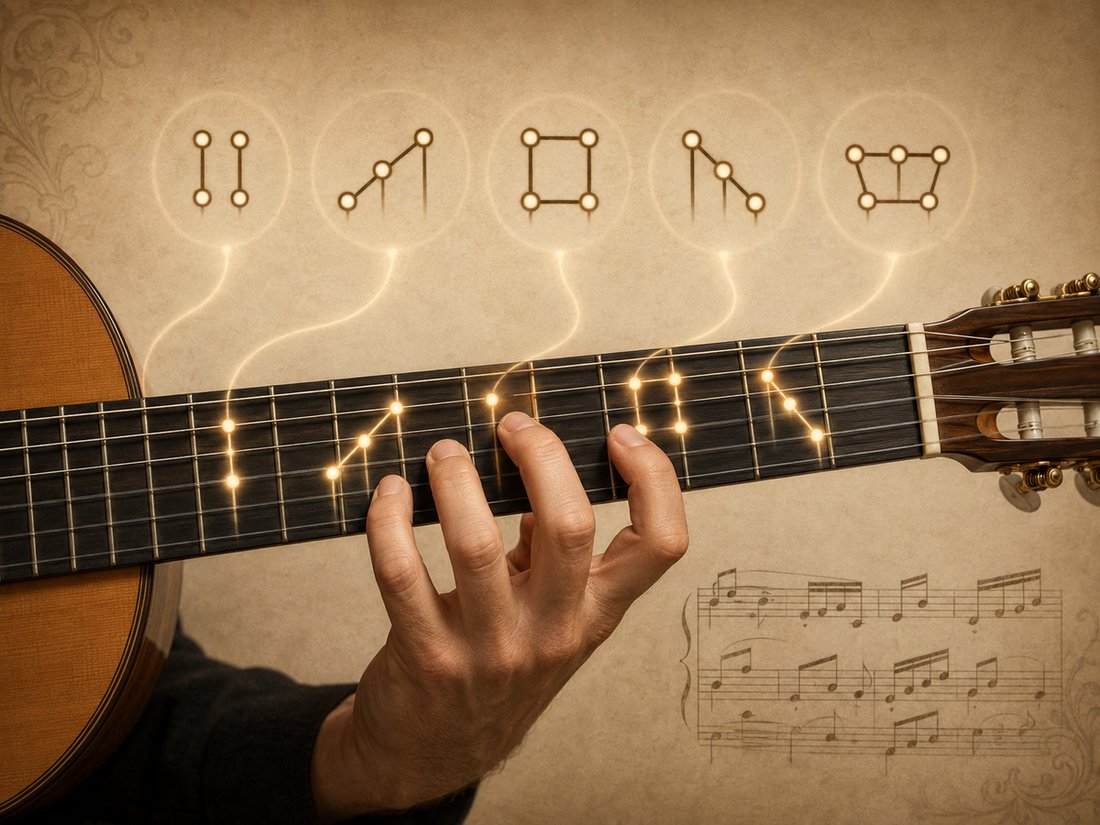
"The slow player gives one command per note. The fast player gives one command for a whole cluster and lets the cluster run." Real speed comes from grouping — and the longest chapter in the book is the workshop for building those groups.
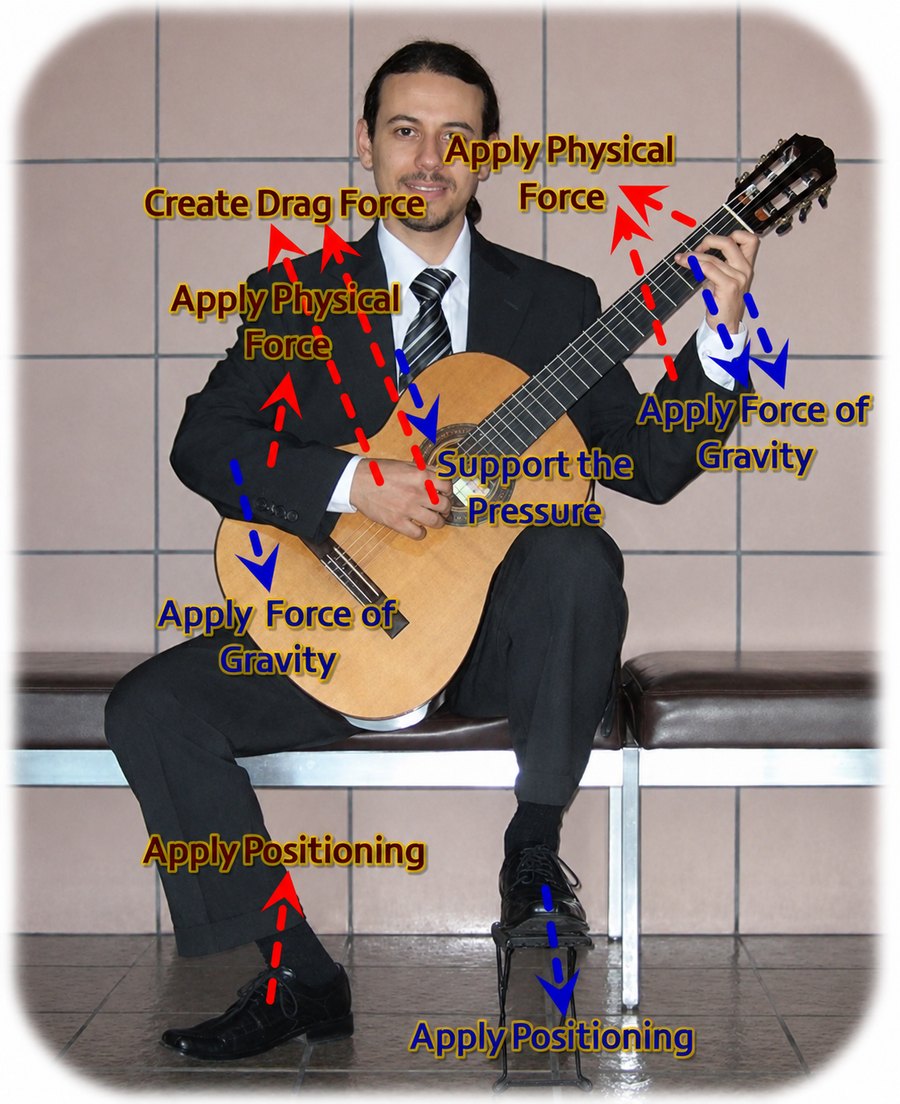
Here is the idea the whole method turns on: your fretting fingers are not supposed to supply the force. Your arm weighs more than any note needs. The only question is how much of that weight you let through — and that is a control you already own, running blind, called sustainment.
Hold more, less weight reaches the string and your fingers pay for every note. Release, and the weight arrives on its own. Set it so the note gets what it needs and no more, and something changes that you feel within a minute: you are resting on every note you play. An hour later, one arm finishes tired. The other finishes the way it started.
And the same engine runs both hands. The right arm has the guitar underneath it, so nothing is being held at all — "my right arm uses the force of gravity and falls over every note." From there the book does what no page this size can: the four moves both hands share, what a finger is actually for once the arm supplies the force, and a one-minute calibration that finds your setting — by ear, with your eyes closed. One principle, both hands, half as much to remember.
A method that never shows you how to find what to work on — or how to make today's discovery survive until tomorrow — isn't a whole method. Two of Dr. Costa's strategies now sit in the book as chapters of their own. Here is the heart of one, free — enough to run tonight — so you can judge the rest by it.
The strategy he has leaned on hardest in thirty years of playing. It starts from a fact most players never face: there are no free repetitions. Every one is a deposit — and you are always making one, wrong notes included.
So the fix is a procedure, not more hours. Stop at the mistake. Isolate it. Three clean in a row, the count back to zero on any miss. Ten to fifteen seconds away. Then one attempt that counts.
That's the procedure. Run it tonight — it costs you nothing. What the chapter adds is why each step is there: what the gap is actually doing to that last attempt, why the count is three and when to raise it, what to do after three failed rounds — and the one step almost every player skips, the step that decides whether tonight's work is still there next week.
If one week of it doesn't change your sessions, the rest of the book won't either. That's a fair way to decide.
"A question is not a request for information. It is an instruction to your attention, and your attention obeys it before you have decided whether to."
Same practice, same results — that isn't a failure of character, it's arithmetic. Improvement means change, and the cheapest instrument of change you own is a question asked on purpose.
One distinction does most of the work, and it's free too: a question is worth asking when its honest answer is something to do, and worth dropping when its honest answer is a verdict on you. Most players spend a whole session on the second kind and call it self-awareness.
The chapter is the rest: four question words and the different thing each one produces, five places in a session to use them, a formula for asking the question you have been avoiding, and a hundred questions written for the practice room.
Playing is governed by thought before it's executed by muscle. So this book trains the mind, the practice, and the performer — not just the hands.
Fear before playing is a weather report, not a verdict. Learn to walk on already in state and give feeling instead of checking notes — you're an emissary of emotion.
Most plans die for a reason — and it's wiring, not weak character. Build a practice that expects off-days, judges the week (not the day), and treats every result as information.
"This is hard" builds the wall it describes. Change the story you carry into a passage — without changing a single note — and your hand starts hunting for ease.
"You did nothing with your hand; the weight arrived."Chapter 5 — Balance
Every chapter ends with an Application — one concrete thing to practice today — and Tests: questions whose honest answers tell you whether the idea has reached your hands.
Where the wasted effort lives, and how to start feeling it.
The setup, the arm's weight, and one model for both hands.
Grouping, tone, and reading music for where the effort hides.
Fear, feeling, and the energy that playing runs on.
The practice system — and the stage it is preparing you for.
The beliefs you play from, the purpose you build, and how the method came to be.
And after the last chapter: a glossary that defines every working term in one line, and a note on the science — what's established, what's a working model, and what's been simplified, said outright.
This is a living method. As Dr. Costa refines it, the book updates inside My Practice Canvas — and you get every update automatically, at no extra cost. The people who bought the first edition did not pay a cent for the second one.
A built-in “What's New” feed shows you exactly what changed and takes you straight to the passage, so you never miss an insight.
And it works in both directions. The book carries a register of retirements — a plain list of everything the method has dropped over thirty years, by name, with the reason. Including the lines students still quote back to him. "On the day something frees me further, I'll change again, and I'll put the old thing in a register like the one above so nobody has to guess what became of it."
Buy once at today's price — every future edition is included.
Thirty years of teaching, for less than the price of a single lesson.
Secure checkout by Stripe. After payment you'll sign in with the same email and the book opens instantly.
One time. You pay once and the book is yours — including every future update, at no extra charge.
After checkout you'll sign in with the same email you used to pay, right here on My Practice Canvas. The book opens in your browser and stays in sync on any device.
Both — the book is written for everyone "as a beginner or as a professional." If you're a complete beginner you'll build effortless habits from day one; if you're advanced you'll find the leaks that have quietly capped your speed and tone.
Test it before you spend a cent. The Learning Game procedure above is free — run it for a week. If it doesn't change your sessions, the rest of the book won't either, and you'll have lost nothing. And inside the book the standard stays the same: "Whatever makes your playing freer, keep. Whatever doesn't, throw out."
It's written at the classical guitar — the setup, the nails, the notation and repertoire are classical through and through. The chapters on practice, speed, fear, and performance apply to any instrument, but every example assumes a classical guitar in your hands.
Yes. The book devotes real space to dismantling the "golden age" myth — adults learn at least as fast. The method is feel-based, and that ability never expired.
This is a living method. As Dr. Costa refines and expands it, the book updates automatically — and a “What's New” feed shows you exactly what changed. It is not a slogan: the second edition added two full chapters and rebuilt several others, and everyone who had already bought the book received all of it free.
The opposite, and the book argues it openly. It carries a register of retirements — everything the method has dropped over thirty years, listed by name with the reason, including lines Dr. Costa's own students still quote back to him. Most methods quietly delete what they no longer believe. This one prints it, so you can see exactly what you're standing on and why.
The first two parts, yes — they build. After that the book is written to be revisited: some chapters land differently after a month at the instrument, once your hands have caught up with the argument. Every chapter ends with an Application (one concrete practice for today) and Tests (questions whose honest answers tell you whether the idea has reached your hands).
No. Buying the book gives you access to the book only. You won't be enrolled with any teacher and you won't appear on anyone's roster.
"A mind braced for a struggle tells the hands to struggle." Stop bracing. Let the arm's weight do the work it was always going to do, group the notes into single commands, and practice with a system that makes what you find dependable. You already have the first procedure, free, from this page — the book is the rest. One payment, lifetime updates, instant access.